UT Austin tuition and cost, 2026–27
Fall-and-spring tuition is $10,858–$13,576 for residents and $42,554–$51,106 for nonresidents. Choose the college, housing period and budget that apply.
In this guide
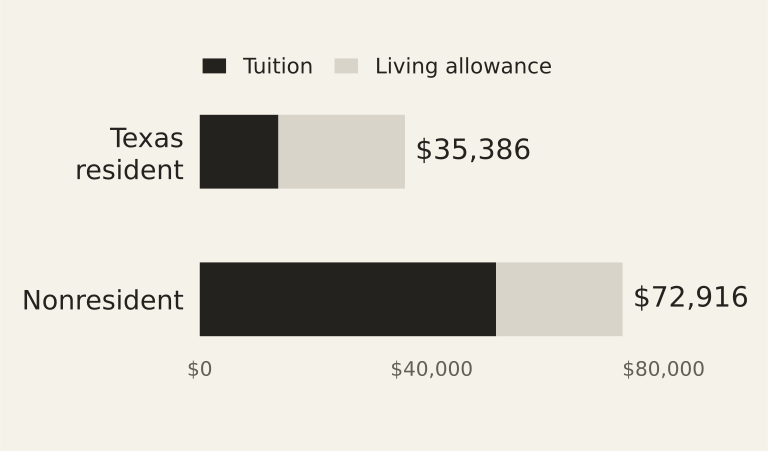
For fall and spring 2026–27, UT Austin’s full-time undergraduate tuition estimate is $10,858–$13,576 for Texas residents and $42,554–$51,106 for nonresidents. Its full attendance budget also includes estimated housing, food and other living costs. Official 2026–27 table
For a usable personal budget, keep three records: the university’s planning estimate, your actual tuition and fee bill, and the full housing agreement. They cover related spending but do not have the same scope, payment dates or contractual meaning.
Official 2026–27 undergraduate budgets and traditional tuition checked October 27, 2026. Authored totals retain semester and occupancy periods. The editable housing inputs are a declared example until replaced with a quote; this is not an aid award, bill or availability feed.
The 2026–27 undergraduate comparison
The official table is labelled fall and spring for full-time undergraduates and notes 12-hour enrollment. Its tuition range varies by program. The living-with-parents column changes the housing-and-food allowance; it does not turn tuition into a different resident rate.
Scroll the table to compare every column.
| Published category | Tuition | Full COA |
|---|---|---|
| Texas resident, on/off campus | $10,858–$13,576 | $32,508–$35,386 |
| Texas resident, with parents | $10,858–$13,576 | $24,998–$27,716 |
| Nonresident | $42,554–$51,106 | $64,204–$72,916 |
One Stop planning ranges, checked October 27, 2026. A tuition bill, an aid award and a housing agreement are separate records.
Keep the living-cost components visible
The official budget is more than rent and tuition. These fall-and-spring allowances use the same published period; actual personal spending and an apartment’s full contract can differ.
Scroll the table to compare every column.
| 2026–27 estimated item | Resident, on/off campus | Nonresident |
|---|---|---|
| Housing and food | $15,420–$15,580 | $15,420–$15,580 |
| Transportation | $1,840 | $1,840 |
| Books and course materials | $724 | $724 |
| Personal / miscellaneous | $3,666 | $3,666 |
One Stop full-time undergraduate fall-and-spring estimates. The living-with-parents housing/food allowance is $7,910; keep that separate from the on/off-campus column.
Use the tuition range as a reference, then check the bill
Residency, program and enrollment belong with any tuition figure. Comparing a resident’s lower range with a nonresident’s upper range without those labels creates a large difference that says little about either student’s actual bill.
Check the charges and payment deadline attached to your own registration. A scholarship, loan offer or family contribution is a funding source; it does not change what a published tuition figure measures.
One Stop describes cost of attendance as an estimate for a typical student and a basis for financial-aid planning. A budget allowance is not a promise that every listed expense is paid directly by the university. What COA means
McCombs has a college-specific semester rate
The official traditional-tuition chart’s Business, 12+ hours row lists $6,788 per semester for a Texas resident and $25,553 for a nonresident. At those rates in both fall and spring, the tuition commitments are $13,576 and $51,106. The same-program difference is $37,530 over the two semesters. Official chart, page 1
Those are calculations from the published college rows. A lighter load uses its own row, and the university charges the higher college rate for simultaneous majors across colleges. Read the actual bill and selected billing program before treating a planning range as your charge.
In the on/off-campus COA, transportation, books and personal expenses sum to $6,230. Adding its housing-and-food allowance produces $21,650–$21,810 of estimated non-tuition costs. Residency changes the tuition comparison; those published living-cost components remain the same in the two on/off-campus columns.
Scroll the table to compare every column.
| Business, 12+ hours each term | Per semester | Fall + spring |
|---|---|---|
| Texas resident | $6,788 | $13,576 |
| Nonresident | $25,553 | $51,106 |
| Same-program difference | $18,765 | $37,530 |
Traditional undergraduate rates for Fall 2026 and Spring 2027. Two-semester values are authored multiplication, not a summer or fixed-tuition quote.
Traditional and fixed tuition use different tables
Traditional tuition is listed for the current semester and college. Longhorn Fixed Tuition is an optional program for first-time UT undergraduates; One Stop says its rate stays fixed for four consecutive academic years and is higher initially because it reflects a projected four-year average. Use the table for your entry cohort when considering that option. Traditional and fixed tables
The resident academic-cost freeze for 2025–26 and 2026–27 does not turn every college, credit load or billing option into one university-wide price. Compare the relevant row and terms, then keep the chosen tuition program beside the housing plan.
Match a housing contract to its complete payment period
The housing-and-food line includes two categories. It is not an apartment rent cap, and the fall-and-spring budget does not establish that a particular lease ends when spring classes finish.
In an illustrative quote, twelve $900 installments, twelve $80 recurring charges and a $200 one-time nonrefundable charge total $11,960. That total still excludes food and any other item omitted from the assumptions. It is an authored budgeting example, not an advertised West Campus price.
If a family plans to fund that contract over nine months, dividing $11,960 by nine gives about $1,328.89 per funding month. The contract’s stated installment remains $900; the larger figure expresses the savings needed to cover the declared full obligation over that shorter funding plan.
The West Campus lease comparison works through two complete hypothetical quotes. Use actual dates, installment counts and fee schedules before substituting a real property.
Living with parents changes one published allowance
The resident-with-parents budget uses $7,910 for housing and food and a total of $24,998–$27,716. Compared with the resident on/off-campus column, that is a published budget difference of $7,510–$7,670. All undergraduate living arrangements
That difference is not automatically a student’s cash saving. A commute, household contribution, parking choice and meal costs can change the personal comparison. Use the university columns to locate the assumption that changed, then replace it with the costs that apply.
Keep summer separate as well. One Stop supplies a distinct Summer 2026 table. Adding a summer lease obligation or summer enrollment requires a deliberate extra line, not a relabelled fall-and-spring total.
COA and net price answer different questions
Tuition is a university charge. COA is a planning budget that includes estimated living expenses. A net-price estimate subtracts estimated grant and scholarship aid from attendance cost; loans provide funding and remain a repayment obligation. UT’s net-price explanation and calculator
Use the official calculator for an aid-sensitive estimate, then reconcile the actual award and bill. A lower estimate is not an aid offer. For the payment and attendance-confirmation step, use the billing guide and One Stop’s current instructions.
Make one dated budget with the missing lines visible
Write the academic term and residency status above the tuition estimate. Beside housing, record the full contract dates, number of installments, required recurring fees, utilities and refundable deposits. Keep refundable cash requirements separate from nonrefundable cost.
For transportation, compare the actual parking and commute options. For restricted-price housing, use the SMART Housing eligibility checklist before treating an advertised rate as available to you.
Finally, put confirmed aid and other funding against the same time period. A budget becomes useful when the unsupported price, missing fee or unconfirmed award remains visible instead of disappearing inside an attractive total.
Questions answered
How much is UT tuition for one year and one semester?
At 12+ hours, the 2026–27 traditional undergraduate chart ranges from $5,429 to $6,788 per semester for Texas residents and $21,277 to $25,553 for nonresidents. The fall-and-spring planning tuition ranges are $10,858–$13,576 and $42,554–$51,106. College, load and billing program matter.
Traditional rate chart · Checked 2026-10-27
What is the difference between tuition, COA and net price?
Tuition is the academic charge. COA adds estimated living costs. Net price estimates attendance cost after grant and scholarship aid; it is not a final aid award or a tuition-payment confirmation.
UT net-price calculator · Checked 2026-10-27
How much more do nonresidents pay?
For the Business traditional row at 12+ hours, nonresident tuition is $18,765 more per semester, or $37,530 more across fall and spring. That compares the same college and load; a different program needs its own row.
Business rate row, page 1 · Checked 2026-10-27
Does McCombs have a different tuition rate?
Yes. The Business column lists $6,788 for Texas residents and $25,553 for nonresidents per semester at 12+ hours in 2026–27 traditional tuition. Do not substitute the university’s low endpoint or a fixed-tuition table for that row.
Business rate row, page 1 · Checked 2026-10-27
How do dorm meals and an apartment lease compare on the same period?
Keep the hall’s nine-month room-and-meal bundle beside the apartment’s full payment count, occupancy dates, food, recurring charges and upfront fees. A twelve-payment lease retains all twelve payments even if you plan to fund it over nine months.
UHD rate period · Checked 2026-10-27
Housing comparisons · Checked 2026-10-26
Sources & dates
- Texas One Stop — 2026–27 cost of attendance and published assumptionsVerified 2026-10-26
- Texas One Stop — registration, payment and attendance confirmationVerified 2026-10-26
- UT Off-Campus Living Resources — affordable housing searchVerified 2026-10-26
- UT traditional undergraduate tuition, 2026–27, page 1Verified 2026-10-27
- One Stop — traditional and Longhorn Fixed TuitionVerified 2026-10-27
- One Stop — net-price definition and official calculatorVerified 2026-10-27
Supporting material
- Download college tuition comparison
Source-dated 12+ hour college rows, with explicit per-semester and two-semester units.